
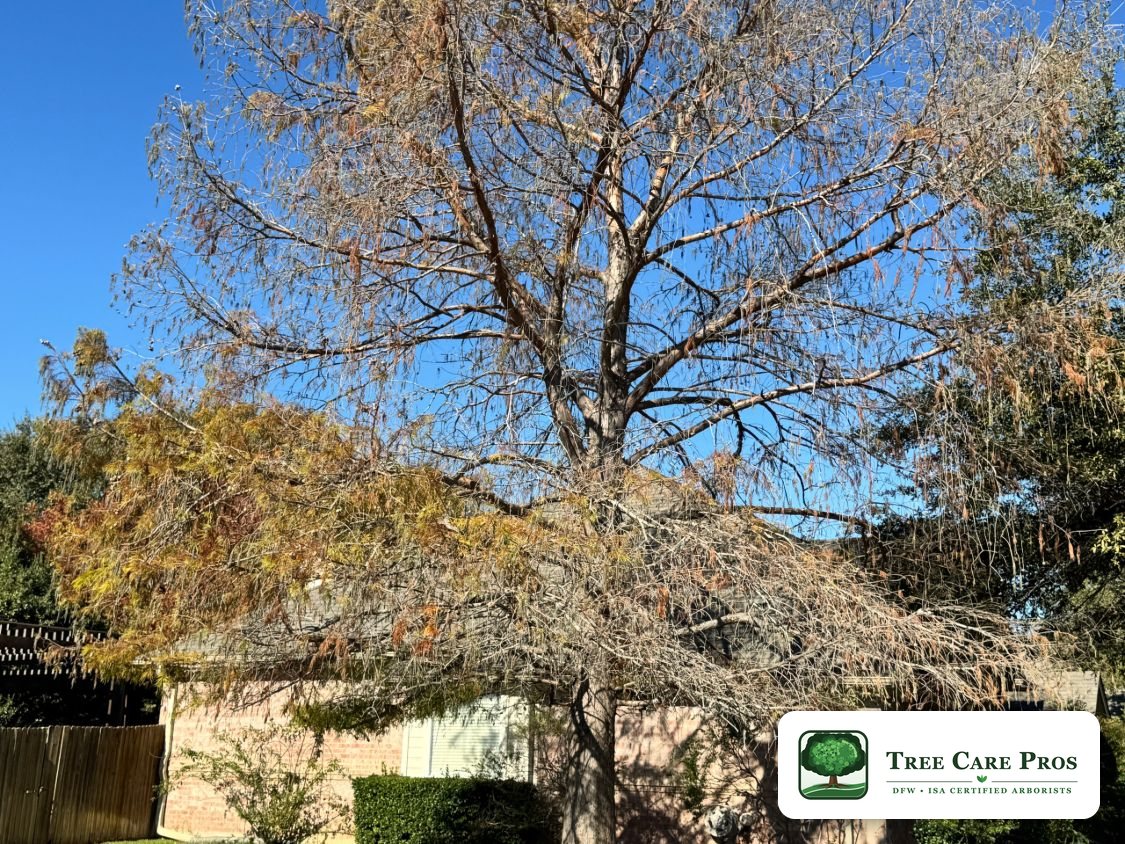
The Bald Cypress (Taxodium distichum) is a beautiful, long-lived deciduous conifer that grows throughout North Texas. Although this species is known for its tolerance of wet soils and periodic flooding, it can also experience serious environmental stress when growing conditions become unfavorable.
When a Bald Cypress begins developing brown foliage, thinning branches, or declining canopy density, homeowners often assume the tree is dying or suffering from a fungal disease.
However, brown foliage does not automatically mean a tree has a disease.
Several environmental and physiological conditions can produce similar symptoms, including drought stress, herbicide exposure, soil compaction, and girdling roots.
Before recommending treatment, it is important to identify the underlying cause.
Watch: a Tree Care Pros arborist looks at a browning Bald Cypress in Granbury. Watch on YouTube
Understanding Bald Cypress and Its Natural Growth Cycle
One important characteristic of Bald Cypress is that it is a deciduous conifer.
Unlike evergreen pines and junipers, Bald Cypress naturally sheds its needles during the fall.
As temperatures cool and daylight decreases, its soft green foliage gradually turns copper, reddish-brown, or rusty orange before dropping.
This is a normal seasonal process.
However, browning during spring or summer, especially when accompanied by premature needle drop, branch dieback, or reduced growth, may indicate environmental stress.
An ISA Certified Arborist evaluates the time of year, distribution of symptoms, root conditions, and environmental history before determining whether the browning is normal or abnormal.
Drought Stress and Premature Browning in Bald Cypress
Although Bald Cypress tolerates saturated soil conditions, it still requires adequate moisture to maintain healthy physiological function.
During extended drought periods in Granbury and surrounding Hood County communities, soil moisture can become insufficient to meet the tree’s transpiration demands.
How Drought Affects the Tree
Water moves upward through the xylem, supplying the canopy with moisture necessary for photosynthesis, cellular function, and cooling.
When soil moisture becomes limited, the tree responds by closing its stomata to conserve water.
This reduces water loss but also limits carbon dioxide uptake, decreasing photosynthetic activity.
Prolonged drought stress can result in:
- Premature browning of needles
- Reduced canopy density
- Early needle shedding
- Slower shoot development
- Reduced carbohydrate production
- Progressive branch dieback
Severe water deficits can also impair the tree’s hydraulic system.
Why Proper Irrigation Matters
Bald Cypress trees benefit from deep, appropriately timed irrigation during extended dry periods.
However, irrigation must be based on actual soil moisture conditions.
Excessive watering can reduce oxygen availability in poorly drained or compacted soils, while insufficient watering can intensify drought stress.
The objective is to maintain adequate moisture without creating prolonged oxygen-deficient conditions around the roots.
Herbicide Damage and Chemical Exposure
Herbicide exposure is another possible cause of abnormal Bald Cypress foliage discoloration.
Throughout North Texas, homeowners and landscape contractors commonly use herbicides to manage weeds in lawns, flower beds, and surrounding landscapes.
Certain herbicides can injure desirable trees through spray drift, direct contact, volatilization, or root uptake, depending on the active ingredient and application conditions.
How Herbicides Affect Tree Physiology
Herbicides have different modes of action.
Some interfere with plant growth regulation, while others disrupt photosynthesis, amino acid synthesis, or other essential metabolic processes.
Potential symptoms include:
- Abnormal foliage discoloration
- Distorted new growth
- Needle browning
- Premature foliage shedding
- Shoot dieback
- Reduced overall vigor
Symptoms vary according to the chemical involved, exposure concentration, application timing, and tree species.
Why Herbicide Injury Can Be Difficult to Diagnose
Herbicide injury can resemble drought stress, nutrient deficiencies, or certain diseases.
A professional evaluation should include a review of recent lawn treatments, product labels, application dates, weather conditions, and the pattern of injury throughout the property.
Visual symptoms alone are not sufficient to confirm herbicide exposure.
Compacted Soil and Root Suffocation
Soil compaction is one of the most overlooked contributors to tree decline in developed landscapes throughout Granbury, Texas.
Heavy equipment, construction activities, vehicle traffic, repeated foot traffic, and improper landscape installation can compress soil particles and reduce pore space.
Healthy soils contain pore spaces that allow oxygen and water to move throughout the root zone.
When these spaces become restricted, root function may decline.
Why Roots Need Oxygen
Tree roots require oxygen for cellular respiration.
Through respiration, roots produce the energy necessary for nutrient absorption, water uptake, cellular maintenance, and new root growth.
When soil becomes severely compacted, oxygen diffusion can become restricted, particularly when the soil remains wet.
This may contribute to:
- Reduced fine-root development
- Poor nutrient absorption
- Restricted root expansion
- Reduced water uptake
- Canopy thinning
- Premature foliage browning
Soil Compaction Can Create Two Different Water Problems
Compacted soils may limit water infiltration, causing runoff and localized drought stress.
They may also retain excessive water in certain conditions, reducing oxygen availability around the roots.
This means a Bald Cypress can experience root dysfunction even when water is present in the soil.
Correcting Soil Compaction
Depending on site conditions, an ISA Certified Arborist may recommend root-zone assessment, pneumatic soil excavation, targeted decompaction, organic mulch, or improvements to irrigation and drainage.
The goal is to restore favorable physical conditions while protecting existing roots.
Girdling Roots and Restricted Vascular Transport
Girdling roots are another important condition that should be investigated when evaluating a declining Bald Cypress.
A girdling root develops when a root grows against or around the trunk or another major root, potentially creating pressure as the tissues expand.
How Girdling Roots Affect Tree Health
As the trunk and roots increase in diameter, pressure from a girdling root may restrict normal tissue development and interfere with vascular transport.
Depending on severity and location, this can contribute to:
- Reduced water movement
- Impaired carbohydrate transport
- Localized trunk constriction
- Reduced root-system efficiency
- Canopy thinning
- Branch dieback
- Progressive decline
However, not every crossing root is a damaging girdling root.
A professional inspection is necessary to determine whether root contact is actually causing injury.
The Importance of Root Flare Inspection
A healthy tree normally develops a visible transition between the trunk and major structural roots.
When the root flare is buried beneath excessive soil or mulch, potential girdling roots and other structural problems may remain hidden.
Careful root flare excavation can help expose the root collar and allow an arborist to evaluate root architecture.
Root removal or correction should only be considered after evaluating the potential consequences for tree stability and health.
Why Multiple Stress Factors Can Affect the Same Bald Cypress
Tree decline is frequently a complex process rather than the result of one isolated problem.
For example, a Bald Cypress may experience soil compaction that limits root development. During a summer drought, the restricted root system may be unable to supply sufficient water to the canopy.
If the tree has also experienced herbicide exposure or root constriction, its ability to recover may be further reduced.
These interacting stressors can contribute to declining vigor and premature browning.
This is why treating only the visible foliage symptoms may fail to address the actual problem.
The most effective approach begins with identifying the primary stress factors and determining which conditions can realistically be corrected.
Why Hire an ISA Certified Arborist in Granbury, Texas?
An ISA Certified Arborist has demonstrated knowledge of tree biology, soil science, tree identification, diagnosis, pruning, and professional tree management practices.
When evaluating a Bald Cypress with abnormal foliage browning, an arborist should consider the entire growing environment rather than focusing exclusively on the canopy.
A professional assessment may include:
- Seasonal foliage evaluation
- Root flare inspection
- Soil moisture and drainage assessment
- Soil compaction evaluation
- Irrigation history
- Herbicide exposure history
- Root architecture inspection
- Canopy density and branch vitality assessment
- Laboratory testing when appropriate
This diagnostic approach helps distinguish normal seasonal needle shedding from environmental stress, root dysfunction, and other potential causes of decline.
Professional Bald Cypress Diagnosis in Granbury, Texas
At Tree Care Pros, our ISA Certified Arborists specialize in identifying the underlying causes of tree decline and developing science-based Plant Healthcare recommendations.
Whether your Bald Cypress is experiencing premature browning, drought stress, suspected herbicide injury, compacted soil, or girdling root problems, our objective is to identify the contributing factors and recommend practical steps to protect your investment.
We proudly serve Granbury, Hood County, and surrounding Dallas-Fort Worth communities.
Contact Tree Care Pros today at (817) 670-4404 to schedule a professional tree health evaluation.